Northern Lights and Wooden Wonders: Chasing Tromsø’s Soul Through Its Architecture
Have you ever walked through a city and felt like the buildings were whispering stories? That’s Tromsø for you. Nestled above the Arctic Circle, this Norwegian gem blends icy wilderness with architectural charm like nowhere else. I didn’t expect wooden churches and colorful old houses to feel so alive—until I saw them glowing under the midnight sun. Here, every structure has a story, shaped by snow, sea, and centuries of resilience. Tromsø is not just a destination for chasing the northern lights; it is a place where architecture speaks of survival, identity, and quiet beauty beneath the polar sky.
First Impressions: Arriving in Tromsø – A City That Defies Expectations
Approaching Tromsø by air or sea is an experience etched in contrast. From the window of a small plane, the landscape unfolds in a mosaic of frozen fjords, jagged peaks, and scattered islands dusted with snow. As the aircraft descends toward Tromsø Airport, Langnes, the city emerges like a cluster of colorful dots nestled on a narrow strip of land between mountain and sea. Despite its remote location—nearly 350 kilometers north of the Arctic Circle—Tromsø pulses with life. It is the largest urban center in Northern Norway, home to over 75,000 residents, and a hub of culture, education, and Arctic research.
What strikes visitors immediately is the harmony between modernity and tradition. Sleek bridges connect islands, and contemporary buildings with clean lines and energy-efficient designs line the waterfront. Yet rising among them are clusters of old wooden houses, painted in vibrant reds, deep greens, and buttery yellows. These historic structures, many over a century old, stand as quiet testaments to a time when survival in the far north depended on ingenuity and community. The juxtaposition is not jarring—it feels intentional, as if the city has chosen to honor its past while embracing the future.
Tromsø’s setting amplifies its architectural character. Surrounded by the Lyngen Alps to the east and the open waters of the Norwegian Sea to the west, the city experiences dramatic seasonal shifts. In winter, darkness reigns for weeks, broken only by the shimmer of auroras and the soft glow of streetlights on snow. In summer, the midnight sun bathes the city in golden light for nearly two months. These extremes shape not only daily life but also the way buildings are designed and experienced. Tromsø does not merely exist in the Arctic—it engages with it, and its architecture reflects that dialogue.
The city’s reputation as a gateway to the polar world is well earned. It has long served as a departure point for Arctic expeditions, from 19th-century whaling voyages to modern scientific missions. This legacy is embedded in its streets and structures. Walking through the city center, one senses a spirit of exploration—not just of the natural world, but of human endurance and creativity. Tromsø feels both remote and cosmopolitan, isolated yet connected. Its architecture tells the story of a community that has learned to thrive where few others would dare to settle.
The Iconic Arctic Cathedral: A Modern Masterpiece in Stone and Glass
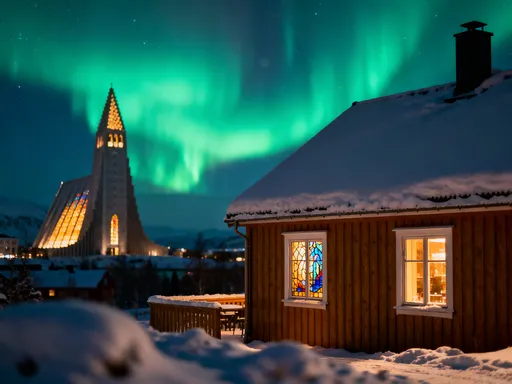
Rising from the Reine peninsula on the outskirts of Tromsø, the Arctic Cathedral—known locally as Ishavskatedralen—is one of the most photographed buildings in Northern Norway. Completed in 1965, this striking structure is not a cathedral in the traditional ecclesiastical sense, but it serves as a parish church and a powerful cultural landmark. Its design, by architect Jan Inge Hovig, captures the essence of the Arctic through form, light, and material. The building’s most defining feature is its soaring triangular facade, composed of 11 narrow, trapezoidal sections that resemble the peaks of surrounding mountains or the jagged edges of sea ice.
The use of concrete and glass creates a balance between solidity and transparency. During the day, sunlight filters through the massive stained-glass window behind the altar, casting kaleidoscopic patterns across the wooden interior. Designed by artist Victor Sparre, the window depicts the resurrection of Christ, rendered in abstract forms and cool hues of blue, green, and white—colors that echo the northern sky and the aurora borealis. In winter, when darkness dominates, the cathedral glows from within like a lantern, its silhouette stark against the night.
Visitors often come not only for worship but for the sensory experience. The acoustics inside are exceptional, making it a favored venue for choral concerts, especially during the winter season. The Tromsø Chamber Choir frequently performs here, their voices resonating through the high vaulted ceiling. In recent years, light installations have also been incorporated, with projections dancing across the facade during festivals, turning the building into a canvas for Arctic artistry.
Beyond its aesthetic appeal, the Arctic Cathedral symbolizes the spiritual and cultural resilience of northern communities. It stands as a beacon—not just of faith, but of human presence in an environment that can be both awe-inspiring and unforgiving. Its modern design breaks from traditional church architecture, reflecting a forward-looking mindset while remaining deeply rooted in its environment. For many, standing before the Arctic Cathedral is not just about seeing a building—it is about feeling the quiet strength of a people who have learned to live in harmony with one of Earth’s most extreme climates.
Skansen and the Charm of Old Wooden Houses
If the Arctic Cathedral represents Tromsø’s modern soul, then Skansen is its historic heart. Located on a small hill just across the Tromsø Bridge, this neighborhood is the oldest residential area in the city, with wooden houses dating back to the 18th and 19th centuries. Walking through Skansen feels like stepping into a living museum. Cobblestone paths wind between tightly packed homes, their facades painted in cheerful colors that seem to defy the long winter months. Bright red doors, white-trimmed windows, and flower boxes—even in the snow—add warmth to the crisp Arctic air.
Many of these houses were originally built as homes for fishermen and merchants during Tromsø’s golden age of trade and Arctic exploration. The wooden construction, using locally sourced pine and spruce, was both practical and symbolic. Timber was abundant, and the lightweight frames could withstand the shifting ground of the island’s soft terrain. Elevated on stone foundations, the homes were designed to stay dry and insulated, with steeply pitched roofs to shed heavy snow. Double-glazed windows and thick walls helped retain heat, crucial during the long, dark winters.
One of the most distinctive architectural features in Skansen is the *rorbue*—a traditional fisherman’s cabin originally used during the winter cod fisheries along the coast. These compact, gabled structures were typically one or two rooms, built for function rather than comfort. Today, many have been carefully restored and repurposed as guesthouses, cafes, or artisan shops. Some retain their original plank floors and wood-burning stoves, offering visitors a tangible connection to the past.
Skansen also offers panoramic views of the city and the surrounding fjords. From its vantage point, one can see how the urban fabric of Tromsø has grown around its natural contours, respecting the land rather than conquering it. The neighborhood’s preservation is a testament to the city’s commitment to cultural heritage. Unlike many northern towns that modernized at the expense of history, Tromsø has chosen to protect its wooden legacy, recognizing that these buildings are not just relics—they are living parts of the community’s identity.
Tromsø University Museum: Where Culture Meets Design
Just a short walk from the city center, the Tromsø University Museum stands as a bridge between education and architectural expression. Part of the University of Tromsø – The Arctic University of Norway, the museum is housed in a functional yet elegant building that reflects Nordic design principles: simplicity, sustainability, and integration with nature. Constructed with local materials such as granite and timber, the structure blends into its coastal surroundings, its low profile and sloping rooflines echoing the nearby hills.
The museum’s exhibitions focus on Arctic natural history, Sámi culture, and the region’s maritime heritage. Inside, glass cases display traditional Sámi clothing, intricate reindeer-hide drums, and tools used in ice fishing and sled making. Interactive displays explain the migration patterns of Arctic birds and the science behind the northern lights. What makes the museum unique is how its architecture enhances the storytelling. Natural light floods through skylights and large windows, creating a sense of openness and connection to the outdoors—a deliberate choice, given that much of what is displayed was shaped by the land and sea.
Subtle architectural nods to indigenous design can be found throughout. The entrance hall features ceiling beams arranged in a pattern reminiscent of traditional Sámi tents, or *lavvu*. Wood paneling in the exhibit spaces uses joinery techniques inspired by stave church construction, honoring Norway’s medieval building traditions. These details are not decorative—they are symbolic, reinforcing the idea that culture and environment are inseparable.
The museum also plays a vital role in preserving and sharing knowledge. Researchers based here study climate change in the Arctic, monitor polar wildlife, and document endangered dialects and traditions. The building itself serves as a model of sustainable design, with geothermal heating and energy-efficient insulation. It is a place where architecture does not overshadow purpose—it supports it. For visitors, especially families and lifelong learners, the museum offers a deeper understanding of what it means to live in the far north, not just as a tourist, but as a steward of a fragile and magnificent world.
Contemporary Architecture in a Polar Climate: Innovation Meets Necessity
While Tromsø cherishes its past, it is also a city of the future. New construction projects across the city demonstrate how modern architecture is adapting to the challenges of the Arctic. The University of Tromsø campus, one of the northernmost universities in the world, is a prime example. Its buildings feature insulated facades, triple-glazed windows, and sloped roofs designed to prevent snow accumulation. Solar panels are integrated into some structures, even though daylight varies dramatically throughout the year. Engineers and architects work closely to ensure that buildings can withstand extreme winds, subzero temperatures, and the constant cycle of freezing and thawing.
Energy efficiency is not a luxury here—it is a necessity. Many new residential developments use passive house standards, minimizing heat loss and reducing reliance on external energy sources. Some buildings incorporate smart glass technology that adjusts transparency based on sunlight, optimizing natural light during the short winter days. Others use heat recovery ventilation systems that capture warmth from outgoing air and reuse it to heat incoming fresh air—a crucial feature in a climate where opening windows is often impractical.
Urban planning in Tromsø also reflects environmental awareness. The city has invested in pedestrian-friendly zones, bike lanes, and public transit to reduce car dependency. New neighborhoods are designed with communal spaces, green roofs, and shared heating systems to foster both sustainability and social connection. Architects are increasingly using recycled materials and designing for longevity, knowing that maintenance in remote areas can be difficult and costly.
What stands out is the balance between innovation and aesthetic warmth. Unlike some modern buildings that feel cold or impersonal, Tromsø’s new architecture often includes wood elements, warm lighting, and human-scale proportions. The goal is not just to survive the Arctic, but to live well within it. This philosophy reflects a broader cultural attitude: respect for nature, commitment to community, and a belief that progress does not require sacrificing beauty or comfort.
Hidden Gems: Off-the-Beaten-Path Structures Worth Seeking
Beyond the well-known landmarks, Tromsø hides quieter architectural treasures that reward the curious traveler. A short ferry ride from the city center leads to the island of Kvaløya, where small coastal chapels nestle beside rocky shores. These modest wooden churches, often painted white with red roofs, serve remote communities and offer moments of stillness amid dramatic scenery. Inside, simple altars and candlelit corners create an atmosphere of reverence and peace.
In the city itself, old warehouses along the harbor have been transformed into cozy cafes and art studios. One former fish-processing building now houses a ceramicist’s workshop, its large windows framing views of the sea. The creak of wooden floors and the scent of pine remind visitors of the building’s past, while the vibrant pottery on display speaks to its new life. Another converted warehouse hosts a small bookstore specializing in Arctic literature, its shelves lined with books on polar exploration, indigenous rights, and climate science.
These spaces invite slow exploration. They are not designed for mass tourism but for authentic connection. Sitting in a sunlit corner of a repurposed boathouse with a cup of herbal tea, watching the light shift across the water, one begins to understand Tromsø on a deeper level. The architecture here does not shout—it whispers. It tells stories of adaptation, renewal, and quiet resilience. For travelers willing to wander beyond the guidebook, these hidden structures offer some of the most meaningful experiences in the city.
Why Tromsø’s Architecture Tells a Deeper Story
Tromsø’s buildings are more than shelters from the cold. They are expressions of identity, records of survival, and acts of hope. Each wooden house, each modern campus building, each coastal chapel stands as a response to the Arctic environment—not in defiance, but in dialogue. The colors of Skansen’s homes lift spirits during the polar night. The Arctic Cathedral reaches toward the sky like a prayer made of stone and light. The university’s sustainable designs reflect a commitment to the future.
Architecture in Tromsø teaches us that beauty and function are not opposites. A sloped roof prevents collapse under snow, but it also creates a graceful silhouette against the mountains. A double-glazed window keeps out the cold, but it also frames a breathtaking view of the fjord. Even the smallest details—door handles shaped like fishing hooks, stair railings carved with wave patterns—carry meaning. These are not accidental choices; they are deliberate acts of cultural storytelling.
In a world increasingly shaped by uniformity and speed, Tromsø offers a different model. Here, development happens with intention. Growth does not erase history—it builds upon it. The city’s architecture invites us to slow down, to look closely, to listen. The walls do speak, if we are willing to hear them. They tell of generations who braved the cold, of communities that supported one another, of a people who found ways to thrive where others saw only hardship.
So come to Tromsø for the northern lights, by all means. Let their green ribbons dance across the sky and fill you with wonder. But stay for the buildings. Walk the quiet streets of Skansen. Stand beneath the towering glass of the Arctic Cathedral. Step into a centuries-old rorbue and feel the warmth of the wood. Let the city’s architecture guide you not just through space, but through time. In the heart of the Arctic, Tromsø reminds us that the most enduring structures are not just made of timber and stone—they are built on resilience, memory, and the quiet courage of everyday life.